


Supporting JMU’s designation as an “R-2” national university, the college faculty engage in research and professional projects to stay up to date with the latest developments and best practices in their disciplines. They share their expertise in the classroom to help students develop the skills needed in the job market. Take a look at some of our faculty members’ most recent accomplishments:
Xu Niu
 Dr. Xu Niu, Assistant Professor of Finance, had a recent publication titled “Strategic CSR in Family Firms,” appearing in International Journal of Managerial Finance (IJMF).
This research, supported by the 2023 COB Summer Research Grant, found that companies which are owned and run by families tend to be more socially responsible than companies that are not family-owned. On average, family-owned businesses score much higher on corporate social responsibility (CSR) measures.
Further analyses show that family firms match or outperform non-family firms across all CSR dimensions, particularly in areas linked to long-term business sustainability.
He also had a paper featured on The CLS Blue Sky Blog, Columbia Law School’s blog on corporations and the capital markets. His co-authored paper, “Hedge Fund Activism and Value Creation in Family Firms,” serves as the basis for the blog post and looks at what happens when activist hedge funds take an interest in family-controlled companies.
The paper was published in Social Science Research Network (SSRN) and shows that investors respond more positively to activist campaigns involving family firms, suggesting they see more potential for improvement. The analysis also finds that these interventions lead to stronger gains in areas like operating performance, takeover activity and transparency.
Piyusha Mutreja
 Piyusha Mutreja, associate professor of economics and international business, had and article titled “Urban bias in capital allocation: Evidence from China,” recently published in Economics Letters.
A joint work with Abdulaziz B. Shifa, Department of Economics, Syracuse University, and Wei Xiao, Research Institute of Economics and Management, Southwestern University of Finance and Economics, China, it examines urban bias in capital allocation using firm-level data from China. The researchers infer the cost of capital from firm returns and compare urban versus rural firms within the same prefecture.
The trio finds that urban firms have significantly lower returns, indicating cheaper access to capital, and this gap is large for state-owned enterprises but negligible for nonstate firms. Also, urban bias in capital allocation is primarily driven by state-directed investment.
Ali Anwar and Carissa Kim
Assistant Professors Ali Anwar and Carissa Kim of the Department of Marketing, and a co-author from U. of Alabama, had their article: “Leveraging coping flexibility to ease emotional exhaustion in salespeople” published in the Journal of Personal Selling & Sales Management.
This study explores how coping flexibility, the ability to adapt coping strategies to changing demands, impacts sales professionals’ emotional exhaustion and performance. Using data from 241 salespeople across multiple sectors, findings show that, on average, greater coping flexibility is linked to lower emotional exhaustion and better performance. However, short-term increases in coping flexibility can temporarily raise emotional exhaustion, even though overall higher levels reduce it over time. These results highlight the complex relationship between coping behaviors and workplace conditions, offering insights for managers on supporting salesperson well-being and performance.
Rhonda Syler and Elham Torabi
Sayahnika Basu
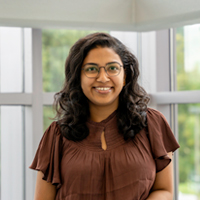 Assistant Professor of Economics,
Josh Bacon
 Josh Bacon, academic advisor in the Advising and Support Center, recently published a chapter on restorative self-care in the 2024 edition of “
Hours of operation:
Mon - Fri: 8 a.m. - 5 p.m.


