


For any questions or concerns about our policies, fines, or safety information,
please contact our office directly.
ResLife Policies
Alcohol & Drugs
Residents and visitors must abide by Commonwealth of Virginia laws referring to alcohol use and possession. It is unlawful for anyone under 21 to purchase, consume or possess any alcoholic beverage. The possession, consumption, or presence of alcohol is prohibited in residence hall rooms if all residents assigned to live in the room are under 21. This restriction does not apply if at least one of the room’s residents is of legal age; however, students under the age of 21 may not consume, possess, or be in the presence of the illegal use of alcohol in residence halls. Loud or disruptive behavior or drinking habits that otherwise interfere with the rights of others or lead to other violations of university policies are reasons for disciplinary action, regardless of student’s age. All residents and involved students may be subject to disciplinary follow up, including fines and/or referral to the Office of Student Accountability. If no one claims responsibility for alcohol found in a student room, suite or apartment, the residents of that unit will be held accountable for the alcohol.
Alcoholic beverages may not be consumed or carried in open containers in hallways, lounges, courtyards, kitchens, Village Area suite rooms, or other public areas. Kegs, distillation processes and other large sources of alcohol such as punches and grain alcohol are not permitted within or near the residence halls, regardless of a student’s age.
Apartments on Grace:
Alcohol is permitted in the living rooms and kitchens of the apartments if one member is at least 21 years old. Apartment residents under the age of 21 may not consume, possess, or be in the presence of the illegal use of alcohol in residence halls.
Residents and visitors must abide by Commonwealth of Virginia laws referring to alcohol paraphernalia.
Students may not possess or use alcohol paraphernalia or devices (e.g., “beer bongs,” “funnels,” beer/water pong tables, etc.) which, by their nature, promote irresponsible consumption of alcohol.
Students are prohibited from storing or possessing empty alcohol containers in rooms, suites, or bathrooms (including but not limited to cans, bottles, shot glasses, and flasks). If empty alcohol containers are found in residence halls, staff will assume that the residents of the room or suite and any students present in the space are or were in possession of alcohol and have a shared responsibility for the containers. All residents and involved students may be subject to disciplinary or Student Accountability follow-up, including fines.
Students may not possess, use, or distribute any illegal drug as defined by the Drug Control Act of the Commonwealth of Virginia. Such possession, use or distribution is prohibited in any building or on any property owned or operated by the university. Possession is defined to include any area or property for which the student is responsible. University policy conforms to state law regarding drug paraphernalia.
Community Engagement
Blood drives may only be scheduled in Village Area TV lounges. These are the only lounges that do not allow easy access to the rest of the residence hall.
The reservation of public residence hall areas for such purposes rests on the following suppositions:
- Social activities carried out in accordance with this policy will benefit both individuals and groups within the hall and lead to increased interaction among residents and a greater sense of community within the hall.
- Students hosting such an activity will assume total responsibility for the planning and conduct of the event including the behavior of all guests, and willingly agree to be fully accountable for the results of such an activity.
- The implementation of this policy will not have a significant negative impact on the educational environment of the residence hall, the physical condition of the building, or the role and responsibilities of the residence hall staff.
- Only residents of the specific residence hall may reserve the recreation room for events.
- No alcohol is permitted at events in public areas.
Designated Room Location
Study lounges and public hallways used as fire exit routes from student rooms are specifically excluded from consideration or use as a designated event area. Due to building design and space usage, some residence halls will not have an event area available in the building. The Hall Director, with approval from the Area Director, may designate an appropriate event space within the hall. The University Safety Director will determine maximum occupancy for the space.
Frequency & Timing of Events
The designated event area will only be available for reservation each weekend on Friday and Saturday nights. No events may be scheduled during weekends before and after final exams. Events may not begin before 7:00 p.m. and must end no later than 1:30 a.m.
Maximum Event Size
The number of individuals permitted to attend a specific event in a given area shall be determined by the formula presented in the Life Safety Code of National Fire Protection Association. The University Safety Coordinator, using the Life Safety Code, shall determine the maximum safe occupancy load for each designated event room. The event hosts shall be fully responsible for ensuring that the maximum occupancy load is not exceeded at any time during a scheduled private event. Because the event hosts, the residence hall staff, and university officials may be held liable or negligent in the event of an accident or death occurring when occupancy of a public room exceeds the maximum safe limit, severe penalties will be imposed on event hosts for failure to control the size of a scheduled event.
Student Sponsor Responsibilities
- Four student sponsors are required to schedule an event and must sign a written event contract and meet with the Hall Director. All four sponsors must attend, as a group, a meeting with the Hall Director. The purpose of this meeting is to request reservations and, if approved, to fully explain the policy and review the responsibilities of the event contract. This meeting must be completed no later than 5:00 p.m. on the Wednesday before the proposed event is to be held. A complete guest list must be turned in to the Hall Director 48 hours (about 2 days) in advance of the event.
- Student sponsors are responsible for insuring that all room entrances are supervised and only invited guests are admitted to the event.
- Student sponsors must attend the event they have registered.
- Student sponsors must have a guest list showing the first and last names of all invited guests. A guest list must be available and checked at the door.
- Student sponsors are responsible for keeping the event under control, and for ensuring that all aspects of this policy, and all other university policies are upheld by event guests during the activity.
- Student sponsors must ensure that no alcohol is consumed or possessed by guests.
- Student sponsors accept full financial responsibility for all damage or theft occurring as a direct result of the event except when specific individuals are identified and accept responsibility for the damage or theft.
- Student sponsors are accountable for ensuring that the event room and the immediate adjacent areas are cleaned by 8:00 a.m. on the morning following the activity. Immediate adjacent area will be described by the Hall Director in the meeting prior to the event.
- Student sponsors should enlist the aid of the Residence Hall staff member on duty at the onset of any difficulties with guests. Contacting a Residence Hall staff member in the event of a problem does not, however, relieve the event hosts of primary responsibility for control of the event and all attending guests.
Events in Room/Suite Areas
- Residents’ rights to study, sleep, and have privacy within their rooms will be maintained. Residents should consult their roommates and suitemates prior to the event to prevent disruptions in the room/suite. Loud or disruptive behavior, lack of cleanliness in the residence halls, or drinking habits that otherwise interfere with the rights of others are reasons for disciplinary action. Room/Suite events are discouraged during weeknights.
- Event sponsors are fully responsible for the behavior of their guests. Failure to control guests’ behavior will result in immediate administrative or disciplinary action. Events in rooms or suites are intended to be relatively small due to the space available and safety and fire regulations.
- The number of people attending an event must be no more than the room can accommodate: six (6) per bedroom, eight (8) in a permanent triple and/or twelve (12) per Village Suite common room. For the Apartments on Grace: six (6) per 1 bedroom double, and twelve (12) per 2-bedroom double.
- Advertisement of room or suite events is prohibited.
- Violations of the alcohol policy may be referred to the university disciplinary system for disposition in the same manner as all other university and residence hall policy violations.
- People who are not invited should be asked to leave the event by the event sponsors. If this request is not effective, the event sponsors should immediately notify the residence hall staff for assistance. The uninvited person(s) may be subject to referral for disciplinary or police action as noted above.
- Inability or unwillingness to control an event or guests, or noncompliance with any provisions of the room and suite event policy on the part of the event sponsors, may result in disciplinary action.
Events in Residence Life Classroom/Programming Spaces
The reservation of the Wayland Hall Performance Space (Wayland G20), Wayland Hall Programming Space (G08), Wayland Hall Art Lounge (117), Logan Hall Programming Space (Logan 009), Gifford Hall Programming Space (Gifford 019), Hoffman Hall Programming Space (Hoffman 0100), Chesapeake Multipurpose Room, Shenandoah Multipurpose Room (Shenandoah 1006), Jennings Hall rooms 135, 139, and Common House, and the classrooms and Great Room at the Apartments on Grace for all activities must be completed through those spaces’ designated Microsoft Exchange Calendar.
PSYC 100 and residence hall activities are given priority. Because the spaces are associated with Learning Communities, the Associate Director for Learning Initiatives and the associated Area Director or their designates have final authorization on activities occurring in the space. Events may only be held in the aforementioned spaces if a Residence Life Staff Member or RLC Faculty Member is present, unless prior permission from the Community Development Office or Learning Initiatives is received. Reservation of these spaces is done as any other resource reservation would be completed on Microsoft Exchange. University and Residence Life policies must be followed at all events held in reservable classroom/programming spaces.
Emergency, Confidentiality & Counseling
Confidential information of a personal nature should not be discussed with any other student without permission from the individual involved. However, confidential information must be discussed with other members of the university staff for professional reasons. “Professional reasons” include those times when a Resident Adviser or Hall Director seeks advice or assistance from other staff members in responding to a situation or when it appears that physical or mental harm may result to the student involved or to other members of the campus community. In instances where a student approaches a staff member “in confidence,” the Resident Adviser or Hall Director should clearly state under what conditions the information is received. For example, staff members may not sanction violations of university policy known “in confidence” by remaining silent. Student staff members should confer with administrative staff members when there is any question as to the proper level of confidentiality to maintain.
Missing Student Notifications for Students Residing in University Student Housing The Clery Act requires institutions that maintain on-campus housing facilities to establish a missing student notification policy and related procedures (20 USC §1092(j), Section 488 of the Higher Education Opportunity Act of 2008).
When it is determined that a residential student is missing from the JMU community, University staff, in collaboration with James Madison University Police, will be guided by this Missing Student Notification Policy and related procedures.
The University will provide every student living in university student housing the opportunity and means to identify a contact person the University will notify if ever the University determines that the resident student is reported missing. Missing student contact information provided by a student will be registered confidentially, accessible only to authorized University officials. JMU officials may not disclose it except to law enforcement personnel in furtherance of a missing-person investigation.
Any individual who believes a student living in university student housing may be missing should immediately contact the University Police Department (JMUPD) at 821 South Main Street, Anthony-Seeger Hall, or by phone at (540)568-6911. The JMUPD will notify the Dean of Students Office (ODS) on receipt of a missing-student report. When such a report is received, both ODS and JMUPD will attempt to determine whether the student is, in fact, missing.
CODE OF VIRGINIA AND SUZANNE’S LAW
President George W. Bush signed Suzanne’s Law as part of the national AMBER Alert bill, amending Section 3701(a) of the Crime Control Act of 1990. This federal law provides that there shall be no waiting period before a law enforcement agency initiates an investigation of a missing person under the age of 21 and reports the missing person to the National Crime Information Center of the Department of Justice. Suzanne’s Law is named after Suzanne Lyall, a student at the State University of New York at Albany, who has been missing since 1998.
Code of Virginia, § 15.2-1718.2. Receipt of critically missing adult reports, Law Enforcement agencies shall not establish or maintain any policy that requires the observance of any waiting period before accepting a critically missing adult report.
Law enforcement agencies shall immediately, but in all cases within two hours of receiving the report, enter identifying and descriptive data about the critically missing adult into the Virginia Criminal Information Network and the National Crime Information Center Systems, forward the report to the Department of State Police, notify all other law-enforcement agencies in the area, and initiate an investigation of the case.
“Critically missing adult” means any missing adult, including an adult who has a developmental disability, intellectual disability, or mental illness as those terms are defined in § 37.2-100, 18 years of age or older whose disappearance indicates a credible threat to the health and safety of the adult as determined by a law-enforcement agency and under such other circumstances as deemed appropriate after consideration of all known circumstances.
If, within twenty-four hours of the report, it is determined not to be a critically missing adult, and JMUPD is unable to locate the missing student, the student remains missing, JMUPD will notify ODS and ODS shall take the following action(s):
- The Dean of Students or his/her designate will promptly notify the individual the student has designated as his/her emergency contact and document the date and time of the notification.
- If the missing student is under 18 years of age and not an emancipated individual, the Dean of Students or his/her designate also will notify the student’s custodial parent or guardian and document the date and time of the notification
When the missing student is located, the Dean of Students or his/her designate will contact the student to offer any appropriate support, as well as the emergency contacts and/or parents to confirm the student has been located. If the initial investigation is unsuccessful in locating the missing student, JMUPD will continue to investigate according to established police procedures.
The Dean of Students will decide further action, if any.
Regardless of whether the student has identified a contact person, is above the age of 18, or is an emancipated minor, JMUPD will inform local law enforcement agencies having jurisdiction in the area that the student is missing within 24 hours.
There are many good resources related to sexual violence, dating violence, stalking, and prevention and advocacy. This list is not exhaustive; however, these are some that we turn to frequently. Whether you’re looking for direct services, want to learn more, or are curious about careers in this field, these can be a good place to start.
JMU Resources
- JMU Victim Advocacy Services*:
- Student Success Center, 3rd Floor
- (540)568–6251
- University Health Center*:
- The Well, Student Success Center, 1st Floor
- (540)568–6178
- JMU Counseling Center:
- Student Success Center, 3rd Floor
- (540)568–6552
- JMU Title IX:
- Holand Yates Hall, 4035
- (540)568–6251
- OSARP:
- Student Success Center, 2nd Floor
- (540)568–6218
- Dean of Students:
- Student Success Center, 3rd Floor
- (540)568–6468
- JMU Police Department:
- Anthony Seeger Hall
- (540)568–6913
Local Resources
- The Collins Center
- (540)432-6430
- First Step
- (540)434-0295
- National Sexual Violence Resource Center
- National Network to End Domestic Violence
- Stalking Prevention, Awareness, & Resource Center (SPARC)
- National Organization for Victim Assistance
- Virginia Sexual & Domestic Violence Action Alliance
- RAINN
- No More
- Love Is Respect
- Know Your IX
- Center for Changing Our Campus Culture
Self-Assessment Resources
Title IX of the Education Amendments of 1972 protects people from sex discrimination in educational programs and activities at institutions that receive federal financial assistance.
The University is committed to providing an environment free from discrimination on the basis of sex. James Madison University provides many resources to students, faculty, and staff to address concerns relating to discrimination on the basis of sex, which includes sexual harassment and sexual violence.
Responsible employees are those who have the authority to address and remedy sexual misconduct and gender-based discrimination or those who a student or another employee would reasonably believe to have such authority or obligation. This includes residence hall staff. Responsible employees must report known details of the incident as well as the names of the alleged victim and respondent.
Confidential employees are those individuals who have a confidentiality privilege to protect the personal identification of an alleged victim. These confidential employees can fulfill their reporting requirements by making general reports for statistical purposes and pattern tracking but do not divulge personally identifiable information without client consent. Confidential employees at James Madison University include the University Health Center, including survivor advocates, counselors, and students volunteering with Campus Assault Response (CARE).
Remember, as responsible employees we should never promise confidentiality. At training we are encouraged to say, “I cannot promise you confidentiality, but I can promise to keep your information as private as possible and only share with those people on campus who need to know.”
If a victim or survivor would like confidentiality, refer them to a confidential employee.
Fire Safety
Candles, incense, and other items producing an open flame are not permitted in residence halls. Candles are prohibited even if there is no intention to burn them, or if the wick is removed. Wax burners and candle warmers are also prohibited.
Any curtains or wall coverings hung in student rooms must be fire-treated or made from fabric that is fire retardant. If students have used spray fire retardant, they should keep documentation of the treatment (in StarRez or the bottle or label from the bottle will suffice). Students should not hang drapes or fabric at or near room doors, ceiling, or suspended from the ceiling, overhead lights, smoke detector or sprinkler head.
Wall Coverage
Excessive decoration on room walls can be hazardous. The State Fire Marshal has set the following guidelines for residence hall room wall coverage: wall coverage not to exceed 50% in buildings with sprinklers; wall coverage not to exceed 20% in buildings without sprinklers
Due to the hazard of fire, the State Fire Marshal & JMU Risk Management have established limits on the amount of electricity that can be safely used on a given electrical unit, and the limited number of outlets in some halls. They have instated the following policies:
- Hot plates, space heaters, air fryers, soup warmers, toaster ovens, sandwich grills and any appliances with an open heating element are prohibited. Also prohibited are air conditioners, ceiling fans, *microwaves (unless supplied by MicroFridge with necessary safety features), extension cords, cube adapters and halogen lamps. Underwriters’ Laboratory (UL) approved drip coffee makers with automatic shutoff are the only approved coffee makers. (*Microwaves are permitted in the kitchen areas of the Apartments on Grace.)
- One mini refrigerator is permitted per resident. Refrigerators may be no larger than 5 total cubic feet in size. The size is indicated on the manufacturer label on the back of the refrigerator. It can also be found by searching for the model number on the manufacturer’s website.
- One MicroFridge is permitted per room.
- If there is a MicroFridge in the room, one additional mini refrigerator (as described above) is permitted.
- In the Village, two MicroFridge units are permitted in the suite common area.
- One MicroFridge is permitted per room.
- Any appliance with a heavy electrical draw, such as a refrigerator, hair dryer, or an iron, must be plugged directly into a wall outlet, rather than a power strips with circuit protection. All power strips must be UL approved, circuit protected, and have a reset button (Note: the reset button is what designates circuit protection, not to be confused with surge protection which does not meet code). Power strips with circuit protection must be plugged directly into a wall outlet. Plugging a power strip into another power strip is prohibited. Power strips with circuit protection must lie flat on the ground or be secured to a flat surface in such a manner that no stress is placed on the power cords. Extension cords of any kind are strictly prohibited. Appliances and furniture that contain an electrical outlet must have a Nationally Recognized Testing Laboratory tag, (typically UL, CSA or CE.) Items discovered without Listing tags, should be photographed and submitted in StarRez
- All appliances should be covered under homeowner’s/renter’s insurance policies. Residence Life and James Madison University are not responsible for damage to students’ personal property.
- Students should not tape over, tamper with, or disconnect a circuit breaker, fuse, network port cable box, electrical socket, light fixture or switches, smoke/fire alarms, or run electrical cords under carpets or doors.
- Stringed holiday lights are not permitted on ceilings and should not pass through a doorway or window. They should be turned off when students are not in the room. LED light strips with double sided mounting tape are strongly discouraged, as they cause wall damage when removed that can result in the resident being billed to repair the wall. No more than three (3) strands of lights should be connected to one another. Paper- covered lights are not permitted.
- Students found with inappropriate appliances in their room or suite will have 24 hours to remove the items and may be subject to a fine if they do not promptly remove the items. A follow-up inspection will occur to verify removal.
Fire Alarms
No student will activate any alarm or attempt to manipulate any electrical or mechanical device for the purpose of creating a false fire alarm.
Failure to Evacuate
No student will disregard a fire alarm signal or refuse to evacuate a building or a section of a building where a fire alarm is sounding.Failure to evacuate may lead to fines and/or charges through the Office of Student Accountability & Restorative Practices, unless previously notified that the fire alarm system is being tested.
Tampering with Fire Safety Equipment or Devices
No student will, without authorization, operate or tamper with any firefighting equipment except for the purpose of extinguishing a fire. Fire extinguishers should not be used if the individual has not been properly trained to use it. In addition, no student shall tamper with or otherwise misuse any fire detection or early warning device, emergency lighting, evacuation systems or emergency telephones. This will result in the student receiving a $75 Fire Safety Fine as well as potential prosecution.
Obstruction of Fire Evacuation Routes
Fire safety regulations require that no loft bed construction materials, boxes, trash, bicycles or other items be stored, even temporarily, in hallways or other public areas. Any act of purposefully preventing someone from swiftly and safely evacuating a building is prohibited.
No items should be suspended from ceilings, overhead lights, smoke detectors or the sprinkler system. No locks may be installed on 2-room suite doors leading to the bathroom, as it is a means of egress. Doors must be able to swing open a full 90 degrees.
Fireworks or Explosives
Possessing, storing or using any fireworks, propane or explosives is strictly forbidden in and around the residence halls.
Door Decorations
Room/suite doors may only have a white board per resident (no cork board) and a name tag per person.
Wall Coverage
Excessive decoration on room walls can be hazardous. The State Fire Marshall has set the following guidelines for Residence Hall room wall coverage:
- Wall coverage not to exceed 50% in buildings with sprinklers
- Wall coverage not to exceed 20% in buildings without sprinklers
Overhead lights
Room overhead lights may not be removed/changed by anyone except University personnel.
Please see individual policies for Candles, Incense & Open Flames, Curtains/ Draperies, Holiday Decorations, Smoke Detectors, and Smoking.
FIRE & SAFETY VIOLATIONS SUMMARY LIST
**See Electrical Appliances Policy for further reference.
- Air conditioners**
- Air fryers
- Candles/incense*
- Ceiling fans**
- Charcoal/lighter fluid (see Fire Safety & Fire Drills policy above)
- Coffee makers (without automatic shut-off) **
- Excessive room/door decorations (see Fire Safety & Fire Drills policy above)
- Extension cords**
- Fireworks/explosives (see Fire Safety & Fire Drills policy above)
- Furniture misappropriation*
- Halogen lamps**
- Holiday decorations*
- Improper use of cords/wires
- Cords and wires with an electrical current should not be subjected to damage by being placed in a high traffic area (ex: on the floor in front of a doorway) or be under carpets/rugs.
- Cords and wires should not pass through or in front of windows, doors, or be affixed to walls or the ceiling.
- Cords and wires (whether an electrical current or not), should not be placed in a way that presents a trip hazard or an obstruction of egress in the event of an emergency.
- Cords and wires should not come into contact with fire suppression equipment, such as sprinklers.
- Refrigerators, appliances with heavy electrical draw (i.e., hair dryers, irons) and power strips with circuit protection should be plugged directly into a wall outlet.
- Power strips with circuit protection should be properly supported and not hanging by their cords. They must lay flat on a surface. Power strips with circuit protection cannot be plugged into one another either.
- No more than three strands of holiday lights should be connected together at one time and should follow all guidelines above. Lights with paper or another flammable material surrounding the bulb are not allowed.
- Lamps/bed risers with outlets**
- Material attached to the ceiling (see Fire Safety & Fire Drills policy above)
- Microwaves (except for Apartments on Grace or rented from MicroFridge with necessary safety features)**
- Multi-plug adapters (without integrated circuit breaker)**
- Obstruction of egress
- Nothing in a residence hall should impede, obstruct, or obscure egress in the event of an emergency.
- Students may not store loft beds, furniture, boxes, trash, bicycles or other items in hallways or public areas.
- No student shall purposefully prevent someone from swiftly and safely evacuating a building.
- Doors (room and suite) should be able to open to a full 90 degrees without being blocked.
- Refrigerators over 5.0 cubic feet**
- Sandwich grills**
- Soup warmers**
- Space heaters**
- Tampering with fire safety equipment (see Fire Safety & Fire Drills policy)
- Toasters/toaster ovens**
- Untreated wall or window coverings (see Curtains/Draperies policy)
- Unsanitary conditions
- Conditions in a room or suite that detract from the overall academic environment or attract pests to the residence hall are prohibited. This includes trash accumulation, not disposing of trash in the proper location, inappropriate use of toilets, and failing to clean properly. Personal trash should be disposed of in the proper location, not in the hallways, bathrooms, study lounges, TV lounges, or other public areas.
Residents and staff should adhere to the following guidelines when decorating for holidays. Staff should pay particular attention during the Halloween and Christmas holiday seasons.
- No open flames (candles, sterno type products, etc.)
- Utilize battery powered lights inside jack-o-lanterns
- No decorations on fire doors
- No decorations in stairwells
- No smoke or haze machines (unless supervised by university or city fire safety official)
- No disabling of exit signs or emergency lighting or tampering with overhead fluorescent fixtures.
- All decorations must be flame retardant or otherwise non-combustible (acceptable products are crate paper/streamers, spider webs that are not excessive in size or covered with flammable items. No black plastic/paper decorations that look like trash bags.)
- Do not block, impede, obstruct, or otherwise obscure any means of egress. Doors must be able to swing open a full 90 degrees.
- Holiday lights may not be hung in public areas or from any ceiling or doorway. Lights should not pass through a doorway or window. No more than three strands of lights should be connected to one another. Holiday lights must be unplugged/ turned off when a room is unoccupied.
- Holiday lights and/or other cords should not be wrapped around fire safety equipment.
- Live Christmas trees are not permitted in residence halls.
If residents find problems with their detectors, they need to report them to the hall staff or complete a maintenance request. All smoke detector problems are reported to maintenance for repair or replacement.
No student should cover or remove a smoke detector.
Fines for Fire Safety Violations
Fossil Fuel CO Detectors
If you have a personally provided CO detector, that sounds, please evacuate the room and dial 911. The local fire department will respond. Below is a list of Residence Halls that have Fossil Fuel CO Detectors:
| Residence Hall with Fossil Fuels | FA System CO Detectors | Floors with CO Detectors |
|---|---|---|
| Apts. on Grace | Yes | 1st & 2nd Floor Rooms |
| Bell Hall | Yes | Basement Mechanical Room |
| Chappelear Hall | Yes | Main Mechanical Room |
| Dingledine Hall | Yes | Main Mechanical Room |
| Eagle Hall | Yes | Ground Floor Room G8 |
| Frederickson Hall | Yes | Main Mechanical Room |
| Garber Hall | Yes | Main Mechanical Room |
| Hanson Hall | Yes | Main Mechanical Room |
| Hillside Hall | Yes | Basement Mechanical Room |
| Huffman Hall | Yes | Main Mechanical Room |
| Lake Area B | Yes | E/F Boiler Room E10 |
| Lake Area F | Yes | S/T Boiler Room S10 |
| McGraw-Long Hall | Yes | Basement Mechanical Room |
| Paul Jennings Hall | Yes | All Rooms |
| Potomac Hall | Yes | Basement & Mechanical Room |
| Shorts Hall | Yes | 1st Floor Mechanical Room (106) |
| Weaver Hall | Yes | Main Mechanical Room |
| White Hall | Yes | Main Mechanical Room |
General Information/Policies
Pets are not allowed in any university owned or operated housing. The only exception to this policy is fish that are kept as pets.
Service animals are permitted in residence halls and other university buildings.
Assistance animals approved by the Office of Disability Services are permitted in university-owned or university-operated housing only. Students with an approved assistance animal must complete the Residence Life Assistance Animal Agreement prior to having the animal on campus.
Students and their guests will be held responsible for theft of or damage/vandalism to university property, residence halls, and any other areas in or around the residence halls. Bills for the cost of repair will be sent to the responsible individual(s). This includes extra housekeeping services required for the removal of blood-borne pathogens (vomit, blood, body fluids, etc.) or acts of vandalism.
Residence Life’s disciplinary procedures attempt to educate residents regarding their roles as members of a residential community. The best educational results occur when the resident is confronted with specific observations concerning inappropriate behavior as soon after the incident as possible. This requires the Residence Life staff members to be assertive in challenging students promptly and judiciously.
Students may not remove university equipment, furniture, or signage from its assigned room, suite, lounge or other area within a residence hall. Unauthorized removal of furniture or signage within a building or from one building to another will be considered misappropriation. This also includes items outside the halls (i.e., picnic tables). Bedroom furniture may not be placed in hall storage rooms. Exception - Bedroom furniture may be taken home for temporary storage as long as it is returned by the end of the academic year. Students will be billed for missing or damaged furniture.
Residents and visitors must abide by Commonwealth of Virginia laws referring to illegal gambling.
- Illegal gambling is defined in the law as the making, placing or receiving of any bet or wager of money or anything of value made in exchange for a chance to win a prize, stake, or other consideration or thing of value, dependent on the result of any game, contest, or any other event, the outcome of which is uncertain or a matter of chance.
- In Virginia, there is an exception in the law that makes gambling legal when such gambling occurs in a private residence which is not commonly used for such games of chance and where there is no operator of the game. When any form of wagering is involved, poker games or other games of chance may be played in student bedrooms, Village suites, and Apartments on Grace living rooms only. These games may not be played in the lobby, TV lounge, study lounge or any other public area in the residence hall.
- When students or visitors are playing poker or other games of chance in their room, no one may benefit from the game in any way other than as a result of the outcome of the game (i.e. students may not charge an entry fee or take a cut of the amount wagered).
- Poker or other games of chance may be organized by the staff and may occur in the public areas of the building (not including Village suites or apartment living rooms) only if there is no entrance fee, no wagering on the outcome, and no prize of any value awarded to the winner. Door prizes are allowed under the law, but these must be awarded on a purely random drawing. These games may not be used as fund- raisers by individuals or groups.
- Football pools or any other form of wagering on the outcome of an event may only occur between students within the bounds of their bedroom, suite, or apartment. These may not be posted or advertised in public areas.
CAN:
- Play in a student room, Village suite, or apartment living room (no operator of the game)
- Benefit from the result of the outcome of the game (only if above applies)
- Organize sports pools or fantasy leagues (for money) if they occur within a bedroom/suite
CANNOT:
- Play in public areas (lobby, TV lounges, study lounges, etc.)
- Have a regularly scheduled game, even in student rooms, Village suite, or apartment living room
- Charge entry fees or take a cut of the amount wagered
- Use games as a means to raise funds
- Advertise sports pools or fantasy leagues (for money) in public areas of the building
Staff
CAN:
- Organize games in public areas of the building with no entry fee, no wagering on outcome, and no prize awarded to the winner (i.e. purely for fun!)
- Give door prizes if they are awarded random by drawing
- Organize games in Village suites or apartment living rooms
- Give prizes to the winner of games, tournaments, or sports pools
- Use games of chance as a means to raise funds
- Organize or advertise sports pools (fantasy leagues, etc.) for betting purposes
A room adequately accommodates the persons to whom it is contracted and a few guests. Overcrowding rooms is a safety concern and an issue of community welfare. Residents may have no more than one guest per resident per night; overnight capacity in the bedroom may not exceed one guest per resident.
- If students plan to have overnight guests, they must obtain agreement from their roommate in advance. Roommates must have full use of their room at all times and must give consent to overnight guests. If roommates do not agree on having an overnight guest, the right of the student who does not want the guest takes priority.
- Guests may stay overnight in student bedrooms only (residents and guests may not sleep in suite rooms, apartment living rooms, lounges, or other public areas) and must use gender-appropriate or gender-neutral bathrooms.
- Guests may not stay on campus overnight for more than two consecutive nights without special permission from the hall director and may not prolong a visit by moving to another room. If additional nights are approved, the Hall Director will document approval of the extended stay via email to the resident and roommate(s).
- Overnight guests must be at least 16 years old.
- Hosts are responsible at all times for the activities and actions of their guests. Guests who violate any residence hall or university policies may be required to leave and the host held accountable. Damages attributed to guests may be charged to the hosting students.
- Hosts may not give their room key or JMU Access Card (JACard) to their guest. Guests are only allowed to visit their host and are not permitted to wander the halls or visit other residents or rooms unless they are explicitly invited and escorted by their host.
- Students may not have overnight guests during final examination weeks.
- When hosting guests in a room, apartment or suite (not overnight), the number of people in the room must be no more than the space can accommodate: six (6) per bedroom, eight (8) in a permanent triple and or twelve (12) in. A Village suite common room. For the Apartments on Grace: six (6) per 1 bedroom double and twelve (12) per 2 bedroom double.
- Roommates or other hall residents who believe their rights are being violated or that they are being imposed upon should first discuss the matter with the other party. If this does not lead to a resolution of the problem, residents should contact their RA or residence hall director.
What is a loft?
A loft bed is any temporary structure or device that is intended to elevate a single sleeping surface from floor level so that it creates additional floor space in a room.
POLICY:
Fines for Loft Bed/Storage Violations
Residents must take full responsibility for the installation and construction of any personal loft beds. The university will not provide such services and assumes no responsibility for the safety of the loft bed. Loft bed construction must be in compliance with the following guidelines:
Temporary Triple Rooms
In temporary triple rooms, a university-owned loft bed will already be installed. Until that room has been de-tripled and the third set of furniture removed, personal loft beds will not be permitted.
Construction
The loft bed must be totally self-supporting with no attachments to walls, ceilings or other furniture in the room. No nails, bolts, or screws will be permitted in room floors, walls, or ceilings.
- Pressure treated lumber is not permitted
- All trash, including wood scraps and sawdust, must be taken directly to the dumpster and not left in hallways, public areas, or trash containers in the hall.
- We recommend that the bed spring be incorporated into the design of the loft.
- The resident is responsible for storage of all bed parts not used in loft construction and is responsible for reassembling the bed at the end of the year.
- JMU furniture may not be stored in residence hall storage areas.
Lofts may not block doorways or windows and should not be in contact with room radiators. Loft construction must not interfere with either the location or operating efficiency of any smoke detector.
Size Limitations
The mattress support area must be no higher than 7 feet from the floor. Ceiling heights vary from hall to hall, but the sleeping surface must be at least 30 inches from the ceiling. Sleeping surface dimensions must not exceed 89 inches long by 47 inches wide.
Any construction of loft beds is at the resident’s own risk; however, Residence Life staff reserve the right to deem a loft bed unsafe or in violation of fire code. Failure to remove or modify the loft may result in an immediate $50 fine and an additional charge of $50 per day for each day until compliance is met. All student-owned loft beds must be dismantled, and original beds reassembled by the Thursday before final exams to prevent unnecessary noise during final exams. Loft beds may also be dismantled after 11:30am on the final day of exam week. University beds must be properly reassembled before residents check out. If the university bed is not assembled, residents will be assessed a furniture misappropriation fine.
If you have any questions regarding this information, contact:
Residence Life; Business Operations
(540)568-7576
Concerns about the potential for mold in college residence halls are not unusual.
To help provide education and alleviate fears, we offer up to date information and resources on our mold webpage.
Metal windows, doorjambs, doors, marble sills, built-in or movable furniture and floors etc. may not be painted. A graphic design and desired location must be submitted on a Paint Authorization form and approved by the Area Director, Hall Director, and residents of the floor before any work is
to begin.
Students may not throw or cause to be projected any object or substance which has potential for damaging or defacing university or private property or causing personal injury or disruptions. This would include throwing frisbees or other athletic equipment inside the residence halls and throwing snowballs or waters balloons or using water guns in or near the halls, including courtyard areas.
The university is committed to providing students with housing in which they may grow and develop both personally and academically. To achieve this type of environment, quiet hours must be established and maintained. The development of an atmosphere conducive to study is the mutual responsibility of all the residents; therefore, the following guidelines are established:
- Students are required to be considerate of the needs of others at all times and to govern the noise level of their music and gatherings accordingly. Courtesy hours are in effect at all times.
- Every residence hall will have Quiet Hours and these hours will be posted throughout the hall. Quiet hours are 11:00 p.m. to 9:00 a.m. Sunday through Thursday and 2:00 a.m. through 10:00 a.m. on Friday and Saturday. Quiet hours will begin on the first evening the residence halls are open.
- Quiet hours are in effect 24 hours a day starting at 10:00pm on the Thursday before exam day until the end of examinations. Hall staff in each area may select a short period of time each day when the quiet hours are not enforced, but courtesy hours will remain in effect at that time.
- The minimum time required for Quiet Hours in every residence hall is from 11:00 p.m. to 9:00 a.m. on weekdays, starting Sunday, and 2:00 a.m. to 10:00 a.m. on weekends.
- Sound Amplification Equipment: Radios, stereos, musical instruments, air horns, and sound amplification equipment may be used by residence hall students as long as the use of the equipment does not disturb other residents, faculty members or neighbors. Sound equipment or musical instruments may be banned from the hall or confiscated if they are the cause of continuous complaints or disruption. The placement of speakers in room or suite windows or hallways is prohibited.
JMU will recycle aluminum cans, newspapers, computer paper, magazines, corrugated cardboard, batteries, plastic grocery store bags, toner and paint cartridges.
Each student room will be inspected once every eight weeks for damage and health and safety hazards. The staff in each building will designate the time of the inspection and notify students appropriately. Submit StarRez documentation or Maintenance Requests for those rooms that are damaged or have health & safety hazards.
Bills or fines will be issued as appropriate and determined by the Area Director.
Smoking is defined as the burning, lighting or use of a tobacco product or marijuana and any other smoking device or equipment that includes cigarettes, cigars, nicotine pouches, electronic cigarettes (e-cigarettes), vaporizers, hookahs, and pipes. Smoking is not permitted in any residence hall room, suite, or floor.
Students of legal age to use tobacco products must go outside the building to smoke and stay away from hall doors and windows. Smoking is not permitted in the Village courtyard areas or on Bluestone Hall porches/patios. Smokers are required to use ash urns to dispose of their smoking material waste and are prohibited from littering state-owned property with smoking material waste. A student(s) will be billed for the cost for tampering with fire safety equipment and/or any cost associated with damage to, or maintenance of fire equipment or room caused by smoking.
Fines for Smoking/Vaping Violations
STATE OR FEDERAL STATUTE AND/OR REGULATION
Effective July 1, 2019, Code of Virginia § 18.2-371.2 prohibits the possession or use of any tobacco product, nicotine vapor product, or alternative nicotine product by any individual under the age of 21, unless the individual is over the age of 18 and is active- duty military personnel. The statute also prohibits sale to, distribution to, purchase for, or knowingly permitting the purchase of such products by any person less than 21 years of age, unless the person is an active-duty military personnel over the age of 18. All residents involved in violation of the statute may be subject to disciplinary follow up, including fines and/or referral to the Office of Student Accountability. If no one claims responsibility for tobacco products found in a student room, suite or apartment, the residents of that unit will be held accountable for the tobacco products. Smoking is defined as the burning, lighting or use of a tobacco product or marijuana and any other smoking device or equipment that includes cigarettes, cigars, electronic cigarettes (e-cigarettes), vaporizers, hookahs, and pipes.
Students or student organizations may not engage in advertising, distributing or selling any goods, services, publications, fliers, tickets or soliciting/requesting information or interviews. They may not solicit, for any purpose, using university telephones, property or buildings. Door-to-door solicitation and/or distribution or collecting information, interviewing or surveying residents in residence halls, is prohibited. Exceptions related to residence halls for the purpose of service programs and fundraising projects must be approved in advance by the Associate Director, Community Development for.
All students or student organizations planning to conduct programs on or off campus requiring an agreement with Non university agencies must obtain the permission of the Director of Student Life and, in some cases, the Vice President for University Advancement.
Non-student and Non university related organizations cannot sell, distribute, or solicit in the residence halls for any purpose whatsoever without written authorization from the Assistant Vice President for Finance. If approved by the Assistant Vice President for Finance and by the Associate Director, Community Development (contact the Associate Director, Community Development first), programs or demonstrations of legitimate products may be presented in residence halls only under the following conditions:
- Presentations by the sponsored persons or company shall be limited to demonstration or display of merchandise and appropriate promotion, except that it may not include solicitation of orders, signing of contracts or exchange of money. The demonstration or promotion shall be such that it does not unreasonably disrupt other hall activities.
- Solicitors may leave calling cards, catalogs or order blanks with students but may not transact business or seek promises for future transactions.
- A member of the residence hall staff must agree to be present to observe the program.
- No resident of the hall or member of the hall staff may profit from presentation by virtue of their role in securing sponsorship of the solicitor. Free gifts, commissions or any other forms of remuneration are not allowed.
- Door prizes, discounts or any other form of free gifts used to promote attendance or to encourage interest must be available to all on an equal basis.
- No door-to-door solicitation or distribution is permitted.
- Residents may not permit their guests to be involved with any type of solicitation of goods, services, or information in the halls.
APPROVAL TO POST FLYERS
These are the two “approved for posting” stamps that Residence Life staff will see on posters and flyers.

The square stamp above is obtained in the Madison Union. This stamp is required for students to post flyers in Approved Public Posting areas across campus. Each residence hall should designate an Approved Public Posting area inside or outside of the building. Students and student organizations are instructed to get their flyers stamped and then visit the Approved Posting Areas personally to hang their flyers. We ask them to visit the halls during Duty Hours whenever possible and ask them to get the staff member’s help in posting the flyers in that hall’s Approved Public Posting Area.
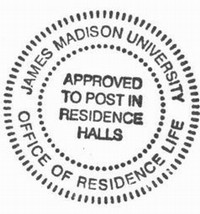
The round stamp above is used by Residence Life to approve flyers given to us by departments like the Counseling Center, Health Center, Libraries, etc. This stamp is NOT used for student or student organization flyers. The round stamp indicates that Residence Life has approved the flyers to be posted by the hall staff in the hall. These flyers may be hung in areas outside of the Approved Public Posting areas in other appropriate locations.
If you would like to post something in the Residence Halls, please send an email with your request and attach your flyer/poster to:
RES-LIFE@JMU.EDU
ATTN: HUGH BROWN & SYDNEY WOOD
The residence hall storage rooms are provided for the convenience of students who use them. No inventory of stored items is made. The university will take reasonable precautions to safeguard the items stored. However, it must be understood that items placed in these areas are stored at the owner’s risk. The university will make no reimbursement for items lost, damaged or stolen. Items stored during the school year must be picked up before the residence halls close for the summer.
-
Tampering with or altering any data, voice, video or other technology ports in bedrooms or public areas of residence halls is strictly prohibited. Installation of cable TV or Ethernet splitters is also prohibited.
-
Students may not use JMU Ethernet or JMU electronic addresses nor ResNet Ethernet and wireless access to conduct private business. The equipment is for educational use only.
-
The installation of personal wireless routers and hubs is not allowed in residence halls because of the high probability of interference and security issues.
-
Any university employee who identifies themselves as a James Madison University employee while engaged in social media activity shall be subject to all university policies and procedures and shall conduct themselves in accordance with the university’s standards of conduct.
Students are responsible for placing their trash in designated areas in the residence halls or in a dumpster or outdoor trash room. Failure to do so may result in disciplinary action and/or fines. Personal trash should not be disposed of in bathrooms or common area trash cans.
The installation of personal wireless routers and hubs and/or cable TV or Ethernet splitters is not allowed in residence halls because of the high probability of interference and security issues.
Housing Policies
The JMU Housing Contract is a legal document between a residential student and JMU. It covers the full academic year (i.e., fall and spring semesters). Resident Advisers and Hall Directors may receive questions from residents on how they can break their housing contracts. Please understand that the contract is a binding agreement. Students are rarely released from the contract.
NOTE – Consideration for contract termination will be given only in cases of exceptional and unforeseeable circumstances. If a resident wants more information, please refer them to section 5 of their contract terms and conditions or have them call the housing office at (540)568-4663.
During breaks in the academic calendar, we encourage residents to take the opportunity to travel home, relax, and reconnect with family and friends. A complete list of residence hall opening and closing dates can be found here. Residence halls close during Thanksgiving, Winter, and Spring Break each year.
We recognize that some students may need to remain on campus during shorter break periods. For Thanksgiving and Spring Break, students requiring housing must submit a Break Housing Request through the Online Housing Portal by the published deadline. Once requests have been processed, Residence Life will provide approved students with additional break housing information via email.
Please note that campus dining options are significantly limited during break periods, and meal plans are generally not available for use.
Students who remain in their residence hall after it closes or return before it reopens without prior approval for break housing may be assessed a daily fee for unauthorized occupancy. Guests are not allowed during break housing.
Please be aware that on-campus housing is NOT available during Winter Break (December through January). We encourage students to plan ahead and make arrangements well in advance of the break period.
JMU has formed a Housing Accommodations Request Committee to evaluate requests based on medical or disability related conditions. It is the student’s responsibility to provide current documentation in order to accurately and equitably evaluate requests. Documentation should consist of an evaluation by an appropriate clinician that specifically relates the current impact of the condition to the request. For more specific information, see the Housing Accomodations page. The deadline for returning students is generally mid-March and the deadline for incoming students is generally mid-June each year.
Students must be the one to initiate the request for housing accommodations.
NOTE: Students are not permitted to install air conditioning units in any university sponsored housing facility
This policy allows a student to change the room assigned to them by Housing. A student may request a room change at specified times during the semester. Students can submit room change requests through the Online Housing Portal using the steps below. While it is not required for students to meet with a hall staff member prior to requesting a room change, it is encouraged for them to do so, as well as notify their current roommate(s).
Room changes will not be processed during (approximately) the first three weeks or the last three weeks of each semester except in special cases and emergencies. However, Residence Life will accept a request for a room change a week prior to the end of the room change freeze. This maximum 3-week room change freeze allows for verification of vacancies and for the reassignment of those students in temporary spaces.
When the third student has moved out of a temporary triple room, the remaining students will have two options. All of the triple furniture will be removed (loft bed, mattress, desk, chair, dresser, and wardrobe) or all of the triple furniture will remain in the room.
If Housing is notified of a student withdrawal/check out first:
-
Housing notifies the Hall Director a student has withdrawn from the University and needs to move out of the building.
-
Housing emails the student to inform them that they need to move out within 48 hours (2 days). Housing emails the roommate so they are aware that the room will be checked.
-
HD must check their space to see if the student has moved out or talk to the student about their plans. If the student has moved out, the HD should document the date of the check out in the StarRez housing system along with documenting that the room key was returned. If the room is completely vacant, a maintenance request should be entered to have the room cleaned
-
If HD cannot find the student in the building and cannot confirm that the space is vacant within 48 hours (2 days), an email needs to be sent to res-life@jmu.edu with an update. Housing will then call the student using home and cell numbers from StarRez.
-
If there is no contact with the student after three days (five days total since the first attempt,) Housing will contact the HD who should work with the Area Director to determine what to do with the student’s belongings. Items will be boxed and stored temporarily while additional attempts are made to contact the student at home by the HD or AD. The student will be checked out of StarRez by Housing on day five, and the space marked as temporarily unavailable until an email stating that the space is vacant has been received to Housing at res-life@jmu.edu.
-
After the student has completed a standard or express check out, the HD should email res-life@jmu.edu with the name of the student, student ID, room number, and date they checked out. This email should be sent within 24 hours of check out.
-
Housing will confirm the student withdrawal with the registrar, check the student out in StarRez, generate refund if appropriate, and cancel the student’s housing contract.
For students with fewer than 12 credits
-
Housing runs a report at the beginning of the semester identifying students who have fewer than 12 credit hours. Students who anticipate a change in their class enrollment are encouraged to email res-life@jmu.edu requesting an exemption to the full-time enrollment requirement in order to remain in their building.
For students enrolled in Zero Credits
-
Should a student not be enrolled in any classes, Housing will contact the student to determine their plans for a) vacating their residence hall or b) enrolling for more credits. Should the student indicate a plan to move out, Housing will email the HD who should follow the checkout procedures above.
-
If the student does not respond to contacts by Housing or the HD, an email will be sent to the student regarding possible trespassing violation. If the student still does not respond and Housing has confirmed that the student has not used the JACard for building access or dining, the student will be checked out of the space in StarRez and the vacancy will be marked as temporarily unavailable until the space can be confirmed as fully vacant. Housing will contact the HD who should work with the Area Director to determine what to do with the student’s belongings. Generally, items will be boxed and stored temporarily while additional attempts are made to contact the student at home by the HD or AD. Once the items are removed, the HD should email Housing at res-life@jmu.edu that the space is vacant and available.
At the conclusion of the academic year, residents are encouraged to properly check- out of their residence hall within 24 hours after completion of their last exam. Students needing to stay past the official closing time must request to do through our late stay request process. All residents who are not involved in graduation ceremonies and living in university housing must check-out by the closing time designated in the Student Handbook unless they have been given permission from Residence Life to stay late.
All residents upon moving into university housing or relocating to a new space on campus must complete a Room Condition form within 7 days. Room Condition Forms can only be submitted once through StarRez.
Safety & Security
Students are not allowed on roofs, ledges, or elevated balconies of residence halls. Students may not sit in or hang objects or persons out of open windows. Students may not throw or drop objects from windows. The deliberate removal of screens from any residence hall window or any damage to a screen is also prohibited and will result in a bill for repair/replacement.
Bicycles may not be kept anywhere inside academic or administrative buildings or in public areas of the residence halls not designated for bicycles. If all residents of a living unit agree, bicycles may be stored in students’ rooms, apartments, and suites. Storage may only occur within designated areas. Bicycles may not be locked to stairwells, handrails, or handicap access ramps.
All bicycles should be registered with the JMU Police, and each bicycle should be numbered. This system of registration is now required to help prevent vandalism or theft. Residence Life is not responsible for lost or stolen bicycles.
Students may not ride bicycles, skateboards, scooters (including electric/gas powered scooters), or other wheeled vehicles in residential facilities. The university will confiscate these items if improperly placed in student housing areas. Students who are found to have caused damage inside of a residence hall because of riding any type of vehicle can be subject to disciplinary action including but not limited to referral to the Office of Student Accountability, paying restitution costs, fines, etc. Wall mountings to store bicycles are not permitted, and any damages caused by the storage or transportation of a bicycle/or other transportation device are the responsibility of the owner. Residents and their guests are responsible for cleaning up any mess resulting from a bicycle, or any wheeled vehicle being brought into or taken out of a residence hall. Electric scooters may be brought into residential facilities; however, the charging of “Bird” or any other commercial electric scooter batteries is prohibited within residential facilities, personal electric scooters must be charged inside student rooms. Electric scooters may not be stored in common areas and the roommate should agree before the device is stored in their room. Motorcycles, mopeds, gas powered scooters and other motorized vehicles may not be brought inside the residence halls and must be parked appropriately outside. Students who violate this policy may forfeit their privilege to store their bicycle(s) and/or electric scooters within the residential facility.
Due to concerns from the Consumer Product Safety Commission and guidance from the Virginia State Fire Marshal regarding the safety of hoverboards, James Madison University prohibits the devices and their chargers in all JMU-owned buildings including residence halls. Hoverboards may not be used, charged, or stored in any JMU owned or leased building.
Tampering with or misuse of elevators is prohibited since it can create safety concerns, damage and excessive wear and tear on elevators.
Residence Halls with elevators:
Residence Hall (# of Elevators in building)
- Alger Hall (1)
- Apartments on Grace (2)
- Chandler Hall (2)
- Chesapeake Hall (2)
- Converse Hall (1)
- Eagle Hall (2)
- Gifford Hall (1)
- Harper Allen-Lee Hall (1)
- Hoffman Hall (1)
- Logan Hall (1)
- Paul Jennings Hall (2)
- Potomac Hall (2)
- Shenandoah Hall (3)
- Shorts Hall (1)
- Wayland Hall (1)
- Wampler Hall (1)
The university is viewed as an educational community; therefore, the courts have upheld the university’s right to enter and search students’ rooms in order to preserve the educational environment. This process may not be used in an arbitrary and capricious manner that unnecessarily deprives a student of fundamental constitutional protection. (In accordance with university housing policy and contract, routine maintenance inspections may be conducted in a manner separate from this policy.)
Each student living in a residence hall will be issued a room key, unless they have a card reader/Mobile ID on their door. No student may lend any key to any other person. Potomac and Harper Allen Lee Hall residents will not have room keys, there is a mobile room door entry lock system in those buildings.
A student who enters or leaves the residence hall is responsible for securing the door. Propping or otherwise preventing any door from being completely secure is a serious safety violation.
Security of each residence hall requires that students lock their bedroom and/or suite doors and keep their keys with them when they leave their rooms. Lost keys should be immediately reported to a Residence Life staff member. Staff members in each hall are able to issue a temporary room key. However, abuse of this staff function or breach of hall security may result in disciplinary action and/or fines.
Residence hall room keys may not be duplicated. Suite combinations may only be shared with residents of the individual suite.
Students are NOT to admit unauthorized or uninvited persons into the residence hall at any time.
What is Mobile ID?
Mobile ID is an app available on Apple/Android devices that will allow students entry into labs, classrooms and their assigned residence halls.
This app does NOT replace JACards
Downloading and Setting Up the Mobile ID App
- Download Mobile ID from the Apple App/Google Play Store
- Open the app: Server URL is cardweb1.jmu.edu
- Click “Authenticate my device”
- Login with your JMU eID and password
- Click “Authorize” and wait for the screen to change
- When prompted, create a PIN to be used to access the app
To use Mobile ID
- Open the Mobile ID app
- Click “Choose” to access a list of recent locations OR type in the location number listed on the reader
- READER: The device that is used to swipe JACards for entry into buildings as well as for dining, laundry, etc.
- Each reader has a label with a 4-digit number
- You will need to enter the 4-digit code into the Mobile ID app when accessing that door
- Swipe the card icon on the screen
For any issues with the card swipe mechanisms or access issues, please submit a maintenance request.
How close do I need to be to the door for Mobile ID to work?
For security purposes Mobile ID must be used within close proximity to the door for the signal to be properly transmitted (about 3-7 feet). You will not be able to let roommates and/or friends into the room when you are not present.
Fines for Policy Violations
| VIOLATION | FINE |
|---|---|
|
Alcohol/Empty Containers |
$75 |
|
Animals |
$50 |
|
Balconies & Roofs |
$50 |
|
Biclycles/Wheeled Vehicles/Hover Boards |
$50 |
|
Bunk Beds/Improper Bunking/Unassembled Beds |
$50 |
|
Candles/Incense |
$75 |
|
Cleaning/Housekeeping |
$50 |
|
Community Standards |
$75 |
|
Early Arrival/Late Departure Moving in early or leaving late at the start or end of each semester or at the start or end of a break period when residential buildings are closed |
$100 |
|
Failure to Evacuate in Fire Alarm/Emergency |
$75 |
|
Fire Safety |
$75 |
|
Furniture Misappropriation |
$50 |
|
Guests |
$75 |
|
Improper Check-Out |
$50 |
|
Improper Storage of Loft Bed |
$50 |
|
Inspection Failure for Loft Bed |
$50 |
|
LOCK CHANGES Standard |
$50 |
|
Lock-Out |
$50 |
|
Loft up after removal deadline |
$50 |
|
Non-Compliance with Official Request |
$75 |
|
Quiet Hours/Noise |
$75 |
|
Smoking/Vaping |
$75 |
|
Suite Combination Change |
$50 |
|
Temporary Access Card Lost |
$25 |
|
Trash |
$50 (Minimum) |
|
Unauthorized Room Change |
$50 |
|
Unwelcoming to potential roommate |
$75 |
|
Wireless Routers/Splitters |
$75 |
Students may be found responsible for damages and will be charged the cost of the repair/replacement.

